
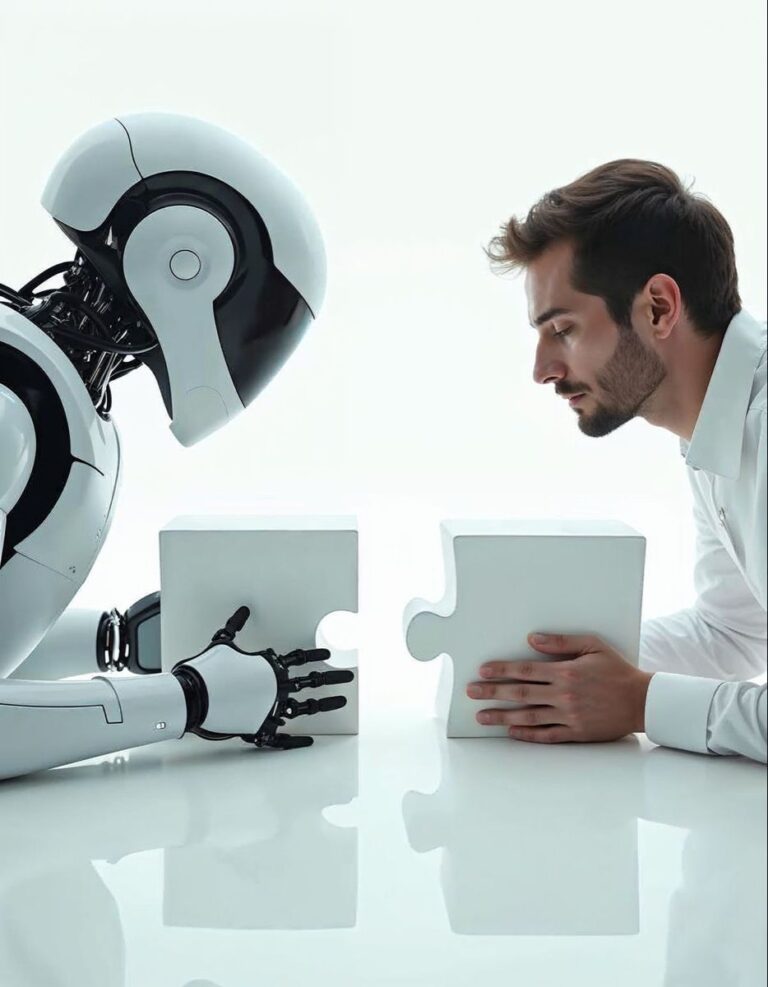
AI: The Death of Creativity or the Birth of a New Era?
Artificial Intelligence has become one of the most powerful forces shaping the modern world. From generating breathtaking artwork and composing music to writing stories, designing products, and creating films, AI is transforming the meaning of creativity itself. But this transformation raises an important question: Is AI slowly killing human creativity, or is it giving birth to an entirely new creative era?
The answer may not be as simple as choosing one side.
The Fear: Is AI Killing Creativity?
For centuries, creativity has been considered one of the most uniquely human abilities. Artists create from emotion, writers draw inspiration from life experiences, musicians turn feelings into melodies, and filmmakers transform imagination into stories. Creativity is deeply connected to human experiences, memories, culture, emotions, and personal identity.
The rapid growth of generative AI has created understandable concerns. Today, a person can enter a few words into an AI system and receive a complete image, article, song, or design within seconds. This convenience creates a risk: what happens if people stop thinking, experimenting, and creating for themselves?
If humans become completely dependent on AI for ideas, creativity could become passive. Instead of asking, “What can I imagine?” people may begin asking, “What can AI generate for me?”
Research also suggests that while AI can improve the quality of ideas in some situations, excessive reliance may reduce the quantity and variety of ideas people generate independently.
There is another concern: sameness. AI systems learn patterns from enormous amounts of existing human-created content. If millions of people use similar tools, prompts, and styles, creative industries could become filled with work that looks impressive but feels increasingly similar.
A world with unlimited content is not necessarily a world with unlimited originality.
The Opportunity: A New Era of Creativity
However, seeing AI only as a threat ignores its enormous potential.
Throughout history, new technologies have often created fear before creating new possibilities. Photography did not destroy painting. Digital cameras did not destroy photography. Computers did not destroy design. Instead, these technologies changed creative processes and opened doors for new forms of expression.
AI may be doing the same thing.
Generative AI can help people overcome technical barriers. Someone with a powerful imagination but limited drawing skills can visualize an idea. A writer struggling with a blank page can explore new directions. A filmmaker can experiment with concepts that once required enormous budgets and production teams.
Studies have found that AI assistance can improve creative performance in certain tasks, particularly by helping people generate and develop ideas.
In this sense, AI has the potential to democratize creativity. Creativity is no longer limited only to people with expensive equipment, professional training, or large teams.
A single person with an idea can now create things that were once impossible to produce alone.
AI Can Generate, But Can It Truly Feel?
This is where the difference between human creativity and artificial intelligence becomes important.
AI can recognize patterns. It can combine concepts. It can generate thousands of possibilities in seconds. But human creativity comes from something deeper: experience.
A human artist may create a painting because of grief, love, childhood memories, cultural identity, or a personal struggle. A musician may write a song inspired by heartbreak. A writer may create a story based on experiences that changed their understanding of life.
AI can imitate the appearance of emotion, but it does not experience life in the way humans do.
Recent research comparing humans and large language models has also found that humans remain particularly strong at the highest extremes of creative performance, showing greater variation and exceptional originality.
This suggests that the future may not be about AI replacing human creativity. Instead, it may be about understanding the different strengths of humans and machines.
AI can explore possibilities.
Humans can decide which possibilities matter.
The Rise of Human–AI Collaboration
Perhaps the most exciting future is not Human vs. AI, but Human + AI.
AI can become a creative partner rather than a replacement. It can help brainstorm ideas, generate alternatives, visualize concepts, and speed up production. But humans can provide direction, emotion, purpose, judgment, and meaning.
Imagine a filmmaker using AI to visualize scenes while still directing the story based on a personal vision. Imagine an architect using AI to explore hundreds of design possibilities before selecting the one that best serves people and communities. Imagine a musician using AI-generated sounds but transforming them into something deeply personal.
The tool may assist the creation, but the human intention gives the work its meaning.
Research on AI-assisted art has found that generative AI can significantly increase creative productivity, while also highlighting the continuing importance of human exploration, selection, and judgment.
This may be the defining creative skill of the future: not simply knowing how to generate content, but knowing what is worth creating.
The Real Danger Is Not AI—It Is Passive Thinking
The greatest threat may not be artificial intelligence itself.
The real danger is what happens when humans stop being curious.
If we use AI to avoid thinking, imagination may weaken. If we use it to copy instead of explore, originality may disappear. If we accept every AI-generated answer without questioning it, we may become consumers rather than creators.
But if we use AI as a tool for experimentation, learning, and exploration, it can expand the boundaries of what humans are capable of creating.
A calculator did not destroy mathematics. It changed how we approach mathematical problems.
AI may do something similar for creativity.
The future will depend on whether we use AI as a substitute for imagination or as a tool to expand imagination.
A New Definition of Creativity
The arrival of AI may force us to rethink what creativity really means.
Perhaps creativity is no longer defined simply by the ability to produce something. Machines can now produce images, music, text, and videos.
Instead, human creativity may become increasingly defined by:
- Original thinking
- Personal experience
- Emotional depth
- Purpose and meaning
- Taste and judgment
- The ability to ask meaningful questions
- The courage to imagine something different
In the age of AI, creating something may become easier.
But deciding what deserves to be created may become more important than ever.
Conclusion: The Beginning, Not the End
So, is AI the death of creativity or the birth of a new era?
The truth is that it could become either.
If humanity allows AI to do all the thinking, imagining, and creating, we risk losing important parts of our creative abilities. But if we use AI responsibly—as a collaborator, assistant, and tool for exploration—it could unlock one of the greatest creative revolutions in human history.
AI can generate possibilities.
But humans give those possibilities meaning.
AI can create content.
But humans create purpose.
The future of creativity will not be decided by artificial intelligence alone. It will be decided by how we choose to use it.
Perhaps AI is not the death of creativity.
Perhaps it is the beginning of a new era—one where human imagination and artificial intelligence work together to create possibilities we have never seen before.